
Loading...
LoadingLoading...
LoadingLoading audit report...


WalletGuard.ai, powered by Gestalt Labs
Forge fork-validation ran but no findings met the threshold for PoC inclusion. See the per-finding "Forge validated" badges in the report below for individual results.
The analyzed contract system is a multi-component NFT and AI agent protocol encompassing bonding curves, governance, reward distribution, staking, and token factory mechanics. The analysis identified 2 critical, 12 high, 18 medium, 7 low, and 5 informational findings after deduplication and scope filtering. The single most dangerous pattern is the complete absence of access control on BMWToken.mint() and BMWTokenChild.setFxManager(), which together allow any attacker to mint unlimited tokens and seize full mint authority with no preconditions. The contract system carries significant security risk in its current state; several high-severity issues affecting reward distribution, proxy initialization safety, and token accounting require remediation before production deployment.
There is no restriction on who can call the mint function of BMWToken. Any person can create as many BMW tokens as they want, sending them to any address. This completely undermines the value of existing token holders and gives an attacker an unlimited supply of free tokens.
The function that controls who is allowed to mint and burn BMWTokenChild tokens can be changed by absolutely anyone. An attacker can appoint themselves as the manager, then freely mint unlimited tokens to themselves or burn tokens belonging to other users.
These reward contracts are deployed behind a proxy but leave their implementation contracts unprotected. Anyone can call the initialization function directly on the implementation contract, grant themselves administrator privileges, and potentially manipulate the reward system or brick the implementation.
5 centralization points identified
Staking mode can be permanently locked if the founder key is lost; there is no admin override mechanism, representing a governance concentration risk.
setCanStake()The Bonding contract owner can burn tokens from any user's balance without consent; while used intentionally for pair unwrapping, the unrestricted scope is a centralization risk buyers must know about.
burnFrom()Single-step admin transfer without a two-step acceptance pattern means an accidental transfer to the wrong address permanently loses admin control with no recovery.
setAdmin()The launchFor function design allows a caller to assign the creator role to any address while retaining all initial tokens; this is either an intentional design or a potential griefing vector depending on the protocol's intent.
launchFor()An attacker calls BMWToken.mint() (no access control) to mint an arbitrary quantity of BMW tokens to themselves. If BMW tokens carry governance or staking weight in any AgentDAO or VirtualGenesisDAO contract, the attacker can use the inflated balance to dominate voting. Combined with AgentDAO's _tryAutoExecute logic that immediately executes a proposal when forVotes equals total supply, the attacker can immediately execute any governance proposal including ones that drain protocol funds or alter reward settings.
An attacker calls initialize() on the bare AgentRewardV2 or AgentRewardV3 implementation contract (which has no _disableInitializers() guard) and grants themselves DEFAULT_ADMIN_ROLE and GOV_ROLE. With GOV_ROLE, the attacker can call setRewardSettings() with invalid share values that cause underflow or zero-distribution conditions. Because setRewardSettings lacks validation that shares sum to DENOMINATOR, the attacker can set all shares to zero or to values that cause systematic arithmetic reversion in _distributeAgentRewards, permanently blocking all reward distribution for the protocol.
If the rewardToken is an ERC-777 compatible token, an attacker who owns multiple service NFTs calls claimAllRewards(). Inside _claimServiceRewards, safeTransfer triggers the attacker's onTokensReceived hook. At this point, claimAllRewards has no reentrancy guard and _claimServiceRewards has no guard. The attacker re-enters claimAllRewards for other NFT IDs whose state has not yet been updated in the current loop iteration, claiming those rewards before the state is marked as claimed. This attack is amplified because the noReentrant locks on _claimStakerRewards and _claimValidatorRewards are per-function and already released after those calls complete, leaving the outer loop window unprotected.
When distributeRewards is called for a newly created agent whose DAO has no proposals (totalProposals == 0), the AgentRewardV3.getClaimableStakerRewards calculation divides by totalProposals, causing a revert. Because claim.rewardCount is advanced before this division in claimStakerRewards (the state update that happens when totalClaimable is computed via the zero-transfer path), the reward epoch pointer is permanently advanced past the broken epoch. All subsequent claim attempts for that virtualId will skip or revert on the same epoch, permanently locking those staker rewards with no recovery path.
AgentRewardV3.getLPValue uses the spot balance of the reward token in the LP pool to determine reward weights. An actor who can donate tokens to a specific LP address (or who controls a large token balance) can inflate that agent's apparent LP value at the time distributeRewards is called. Because the reward split is proportional to these spot balances, the manipulator can redirect the majority of a reward distribution to a chosen agent. This is compounded by the division-by-zero risk in getClaimableStakerRewards if totalProposals is zero, which could be used to knock out competing agents from claiming their share while the manipulator's agent accumulates.
| Agent | Status | Findings | Severity | Confidence | Duration | Coverage |
|---|---|---|---|---|---|---|
| reentrancy | success | 11 | 2H2M2L | 74% | 1.7m | Cross-function reentrancy in AgentRewardV2 and AgentRewardV3 claim functions, Custom noReentrant modifier implementation (storage bool) across all contracts, ERC-777 callback reentrancy vectors via safeTransfer in reward contracts, CEI pattern compliance in all withdraw/claim functions, Division by zero edge cases in reward distribution math, FERC20 custom ERC20 implementation for invariant violations, Genesis contract onGenesisSuccess replay and state overwrite issues, AgentInference zero-address TBA transfer risk, Bonding contract unwrapToken logic and approval mechanics, AgentVeToken stake/withdraw reentrancy (noReentrant present), AgentFactoryV2/V3/V4 withdraw and execute functions (noReentrant present), ERC-1155 callback patterns (not present in this codebase), ERC-4626 vault patterns (not present), Flash loan callback patterns (not present) |
| access control | success | 13 | 4H1M2L | 82% | 2.0m | Access control on all public/external functions across all contracts, Initializer protection and _disableInitializers() usage in upgradeable contracts, Reentrancy protection patterns (noReentrant vs OpenZeppelin ReentrancyGuard), Signature verification and authentication patterns, Delegatecall usage and proxy safety, Role-based access control (RBAC) with AccessControl and AccessControlUpgradeable, Ownership patterns in Ownable/Ownable2Step contracts, Token transfer and approval patterns, Division by zero edge cases in reward calculations, State machine transitions in Genesis and Bonding contracts, Cross-function reentrancy in reward claim functions, Agent validator registry access control, Bonding curve graduation and token unwrapping logic, ERC-2771 meta-transaction context in _msgSender() overrides, Governance proposal and voting security |
| economic | success | 15 | 3H3M1L | 77% | 1.9m | Flash loan attack vectors in reward contracts and governance, Oracle manipulation in AgentRewardV3 LP value calculation, Governance attack vectors in AgentDAO and VirtualGenesisDAO, Reentrancy patterns across all contracts with custom noReentrant modifiers, Reward distribution logic and division by zero risks, Access control patterns across all contracts, MEV exposure in Bonding contract, Genesis contract state machine and timing logic, ContributionNft minting access control, AgentFactoryV4 custom token liquidity addition, AgentVeToken staking and withdrawal logic, AgentRewardV2 and V3 claiming logic for stakers, validators, and service contributors, ERC20 standard compliance in FERC20 and BMWToken, AgentInference prompt and promptMulti functions |
| logic validation | success | 17 | 8M2L | 76% | 2.3m | Input validation on all public/external functions (array length mismatches, zero-value checks), Arithmetic safety - division by zero, integer overflow in reward calculations, Reward distribution logic in AgentRewardV2 and AgentRewardV3, Reentrancy vectors in claim functions with custom noReentrant modifier, Genesis lifecycle state machine (participate, onGenesisSuccess, onGenesisFailed, cancelGenesis), Bonding curve graduation flow in Bonding.sol, Access control on privileged functions (GOV_ROLE, ADMIN_ROLE, BONDING_ROLE), ERC20 token handling (SafeERC20 usage, approval patterns), Loop bounds and gas DoS vectors, Precision loss in share calculations, AgentInference prompt and promptMulti edge cases, AgentTax swap mechanics and creator fee distribution, AgentFactoryV3/V4 application lifecycle, AgentVeToken staking and withdrawal mechanics, ContributionNft and ServiceNft mint access control |
| code quality | success | 19 | 82% | 2.8m | ERC-20 conformance (FERC20, AgentToken, VirtualToken), ERC-721 conformance (ContributionNft, ServiceNft, AgentNftV2), ERC-1155 - not applicable, ERC-2612 permit - veVirtualToken, AgentToken, ERC-4626 vault - not applicable, ERC-1967 proxy upgrade safety and storage collisions, Reentrancy across all contracts with noReentrant/nonReentrant, Access control on all privileged functions, Arithmetic precision and division-by-zero in reward calculations, Bonding curve graduation logic, Genesis contract success/failure state machine, Validator reward distribution correctness, Agent factory application execution flow, Token burn accounting in FERC20, Slippage protection in AgentTax, AgentDAO auto-execution logic, AgentVeToken delegation mechanics, Gas optimization opportunities in loops, Cross-function reentrancy in reward claims, ERC-6551 token bound account integration | |
| compiler bugs | success | 8 | 3M | 78% | 1.4m | AgentInference prompt and promptMulti - token transfer flows, reentrancy, input validation, AgentRewardV2 - distribution logic, claim logic, reentrancy guards, division-by-zero risks, AgentRewardV3 - distribution logic, claim logic, division-by-zero in totalProposals/totalStaked, LOOP_LIMIT pagination, ContributionNft - minting access, admin management, ServiceNft - mint access control, impact calculation, Bonding/FERC20 - burnFrom access control, graduation flow, FFactory/FRouter - role-based access, tax handling, Genesis/FGenesis - participation, success/failure flows, state machine correctness, AgentFactoryV2/V3/V4 - application lifecycle, reentrancy, role checks, AgentVeToken - staking, withdrawal, delegation, AgentNftV2 - minting, validator management, blacklist, AgentDAO - voting, auto-execution, maturity calculation, Reward calculation arithmetic - precision loss, division by zero, Custom noReentrant modifier usage vs OpenZeppelin ReentrancyGuard, Compiler bug patterns - pragma is ^0.8.20, no affected version ranges apply |
| assembly safety | success | 16 | 2M | 77% | 2.2m | Full codepoint scan for non-ASCII characters, RTLO (U+202E), zero-width joiners/spaces, and homoglyphs in all identifiers, comments, and strings - none found, All assembly{} blocks in FixedPointMathLib.sol, ERC6551BytecodeLib.sol, AgentFactory contracts, Airdrop.sol, and AgentToken.sol - checked for hardcoded slots, mstore overwrites, return vs leave, reversed shl/shr arguments, Reentrancy patterns in AgentRewardV2, AgentRewardV3, Genesis, Bonding, Division by zero vulnerabilities in reward distribution logic, Access control across all contracts, ERC20 standard compliance in FERC20, Governance logic in AgentDAO, VirtualGenesisDAO, VirtualProtocolDAO, Bonding curve graduation logic, Genesis contract success/failure flow, Proxy upgrade safety for upgradeable contracts, Storage layout in upgradeable contracts, ERC6551 TBA creation patterns, Reward claiming functions in AgentRewardV2 and AgentRewardV3, Token unwrapping in Bonding contract |
| l2 specific | success | 17 | 6M | 73% | 2.7m | AgentInference: prompt and promptMulti token transfer logic, reentrancy guards, AgentRewardV2: reward distribution, validator reward calculation, contributor reward calculation, claim functions, custom noReentrant mutex, AgentRewardV3: reward distribution, claim functions, division-by-zero risks, LOOP_LIMIT logic, ContributionNft: mint access control, admin management, ServiceNft: mint access control, impact calculation, Bonding: launch, buy, sell, graduation logic, access control, FERC20: token implementation, burnFrom access control, FFactory/FRouter/FPair: AMM mechanics, access control, FGenesis/Genesis: genesis lifecycle, participant management, token distribution, AgentFactoryV2/V3/V4: application lifecycle, TBA creation, token deployment, AgentNftV2: NFT management, validator registry, blacklist, AgentToken: ERC20 with tax, autoswap mechanics, AgentVeToken: staking, withdrawal, delegation checkpoints, AgentDAO: governance, vote counting, auto-execution, VirtualGenesisDAO/VirtualProtocolDAO: quorum, early execution, AgentTax/BondingTax: fee collection, swap mechanics, Minter: reward minting, impact calculation, veVirtualToken: oracle transfer, transfer restrictions, BMWToken/BMWTokenChild: access control on mint functions, Airdrop: assembly-based batch transfer, TBABonus: bonus distribution, LPRefund: refund mechanics, EloCalculator: ELO rating math, Cross-contract reentrancy paths between reward claim functions, Integer overflow/underflow in reward calculations, L2-specific patterns: no L2-specific imports or predeploy addresses found; contract appears to be Ethereum mainnet (chain ID 1 per metadata) |
| upgrade | success | 14 | 4H3M1L | 85% | 2.2m | Proxy pattern identification (ERC-1967 transparent proxy), Implementation contracts missing disableInitializers() constructor, Storage layout and upgrade safety across AgentRewardV2, AgentRewardV3, AgentFactoryV2, AgentFactoryV3, AgentFactoryV4, Custom reentrancy guard implementations vs OpenZeppelin ReentrancyGuardUpgradeable, Division by zero vulnerabilities in reward calculation functions, Access control on admin functions (GOV_ROLE, ADMIN_ROLE, BONDING_ROLE, FACTORY_ROLE), Genesis contract state machine and reentrancy protection, Bonding contract graduation flow and unwrapToken access control, AgentDAO maturity calculation edge cases, FERC20 burnFrom and token distribution mechanics, AgentToken tax and liquidity mechanisms, AgentVeToken staking and withdrawal logic, ContributionNft and ServiceNft minting authorization, ERC2771 meta-transaction context usage, Integer overflow/underflow (Solidity 0.8.20 has built-in checks), Reward claim state machine correctness, Loop limit enforcement in AgentRewardV3 (LOOP_LIMIT = 100) |
This automated audit has inherent limitations. The following areas are not covered.
This report is an automated point-in-time assessment and does not guarantee protection against all possible attacks. It does not cover off-chain components, economic modeling, or business logic correctness unless explicitly noted. Changes to the contract after the audit commit are not reviewed. This is not financial or legal advice. WalletGuard, powered by Gestalt Labs, provides this analysis as-is with no warranty of completeness.
[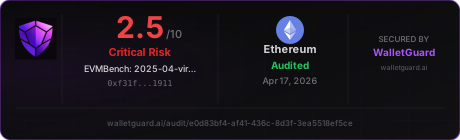](https://walletguard.ai/audit/e0d83bf4-af41-436c-8d3f-3ea5518ef5ce)
<a href="https://walletguard.ai/audit/e0d83bf4-af41-436c-8d3f-3ea5518ef5ce">
  <img src="https://walletguard.ai/api/badge/e0d83bf4-af41-436c-8d3f-3ea5518ef5ce" alt="WalletGuard Audit Badge" />
</a>
Secured by WalletGuard